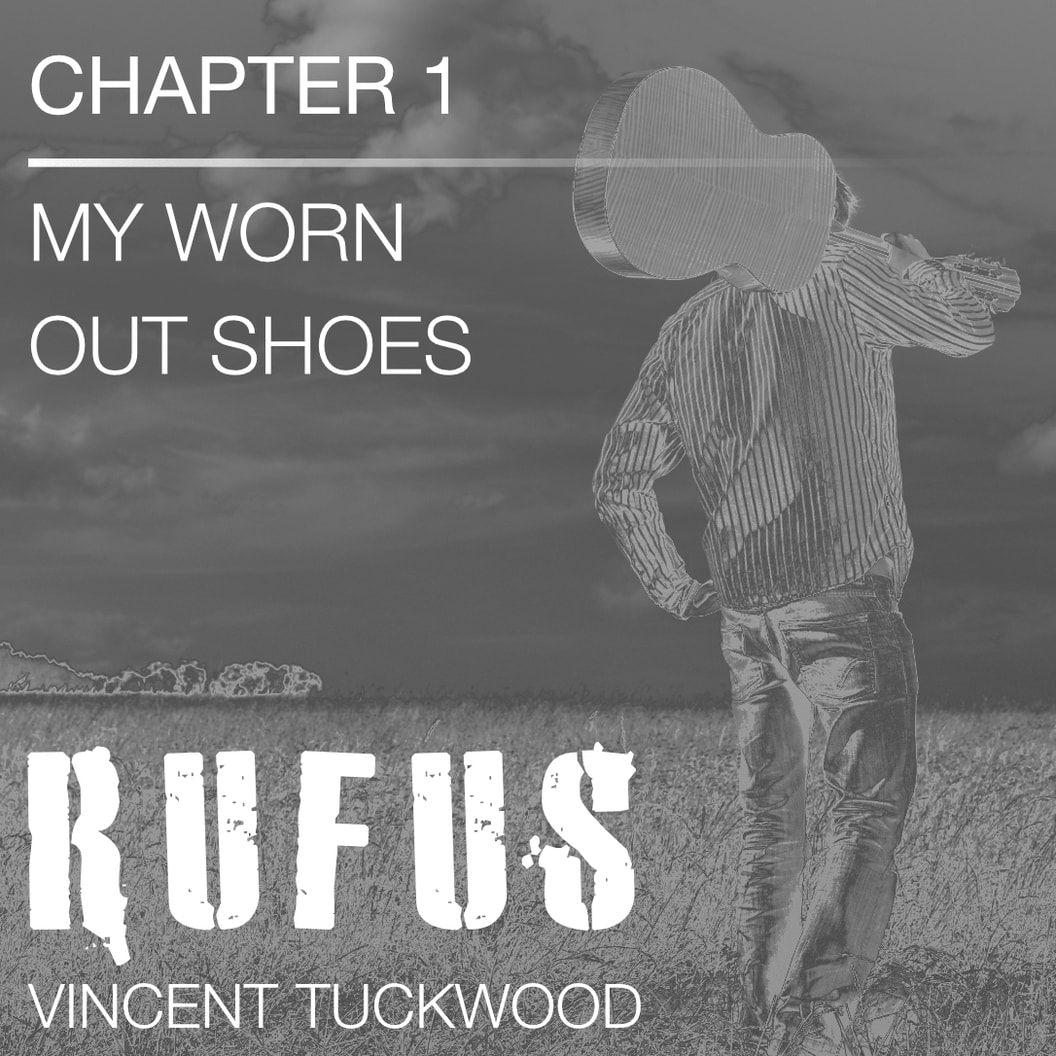
He walked, this twenty year-old boy; a guitar on his back, all his world in a Red Flyer cart. His every footfall sent gravel skittering, puffing dust about his worn-out sneakers.
He walked to the rhythm of the day and night, sun and moon.
He walked where his song led.
I’m just another singer, he thought.
And this is just another song.
* * *
As Rufus crested the rise, the trees fell away on either side. Below, in a dimple puckering forest and field, the town rested easy in the morning mist.
Behind, the forest twittered songs of waking, the scurrying of night creatures back to lair and warmth, the creak of trees in slight breeze.
“Good morning,” Rufus said to the dawn birds, to himself, to no-one.
He shifted the weight of the guitar on his back, took the handle of his cart and continued on down the road.
* * *
The town slept, still too early to be up and about. These lazy summer mornings of mist and pleasant dreams, these picture postcard skies, church spires and picket fences.
The town slept.
* * *
Rufus hummed as he walked, a small sound in the cooling noise of the wild. His neck ached from too many nights sleeping in the forest, from his decision not to hitch the last couple of days.
Sure, he’d had his reasons, wanting the return to the soil, to reconnect with the Mother, recharge his muse. But it hadn’t just been the muse, had it?
His loner-streak.
His walking self.
After the city and the suburbs, he’d simply wanted to be on his own. In the silence. Away from the distraction of the to-and-fro, the calamity of chance conversations and grumbling traffic.
Away.
Walking.
He stopped and looked at the sign by the side of the road.
“Anywhereville,” he said, smiling, “population, more than necessary.”
He bent to his cart and pulled a water canteen, near empty. Drank.
From the town, the sound of an engine.
Rufus replaced the canteen, stood straight, looked towards the sound. He breathed once, deeply, then took the handle of his cart once more.
“OK,” he said, and walked towards the town.
* * *
A couple of hundred yards further down the hillside, as he turned a corner between some hedgerows and a stone wall, he saw the pickup.
By now the noise of its exhaust and roaring engine had decimated the peace of his descent.
Behind the wheel, a guy in a baseball cap and sunglasses.
Rufus moved to the right-hand side of the road as he walked, the camber beginning to pull at the cart, pull at his hands.
The pickup continued on, slowing as it approached him.
Rufus stopped walking, watched the vehicle close the distance.
It came to a halt, window descending.
“Morning,” Rufus said to the driver.
“Yup,” the driver replied.
It was difficult to tell the man’s age as most of his face was taken up with the cap and sunglasses, but he was definitely older, at least in his late forties. His sunglasses were mirrored, reflecting the green of the fields, the blue sky emerging above the tree-line, and Rufus, standing in the road.
Rufus hadn’t seen a mirror for a few days and had chance to notice how much his beard had grown in.
The driver nodded at Rufus’ cart.
“Just coming into town?”
“Sure,” Rufus replied.
He’d had this conversation before; too many times.
“And then on through,” he added.
“Oh,” the driver said, nodding slowly, “musician, huh?”
Rufus smiled.
“Yup. Singer, songwriter, you know?”
“Really. What do you play?”
Rufus smiled.
“You name it, I’ve played it. Mostly it’s just me and my guitar, trying to change the world a little bit for the better. We play a few shows in a town, then move on through. Don’t like over-staying our welcome.”
The driver smiled slightly at this.
Rufus noticed how the man’s smile was kind of crooked and, as always happened, as soon as he saw it, he found it difficult to stop staring.
“Well, it beats working,” he said, working hard to move the conversation forward.
“Like you’ve ever tried that,” the man laughed.
Rufus shrugged.
“You should play to some of the crowds I’ve played to,” he joked, “I’ve done my share!”
The driver’s face remained stone.
Rufus knew where this was headed. Time to move on before this small-town bully decided to have his fun.
He reached out for the handle of his cart.
“Nice talking,” he said, “but I’ve got to…”
“Why don’t you get a real job?” the driver said, though it wasn’t a question.
Rufus knew the answer: say nothing.
He did just that.
“Huh?” the driver continued. “When was the last time you paid any taxes? Did anything worthwhile?”
Rufus remained silent, but could feel the tension coming off the other man. It was in the firm set of his lop-sided mouth, the muscles in his neck, his fist on the steering wheel.
Bad news, he thought, this guy is bad news.
“Yeah, whatever,” Rufus said and started to walk towards the town, leaving the pickup behind.
“Don’t think you can change anything here,” the driver crowed, “you’re wasting your time!”
Suddenly, the engine roared and, fearing the driver wanted more than a traded insult, Rufus glanced over his shoulder. To his relief, the pickup was continuing on up the rise.
He turned back and started walking again.
I sing for change, he thought to himself, smiling, of course I’m wasting my time.
Soon enough, the sound of the pickup, and the memory of its thin-lipped driver, faded to nothing behind Rufus, whose worn-out shoes carried him on into the town.
RUFUS – A NOVEL is a novel-in-progress by Vincent Tuckwood, a Brit author living and working in Waterford, Connecticut, USA. Read more by Vincent Tuckwood.